As UNIDO convenes in Riyadh, Saudi-Africa partnerships show the path beyond self-reliance
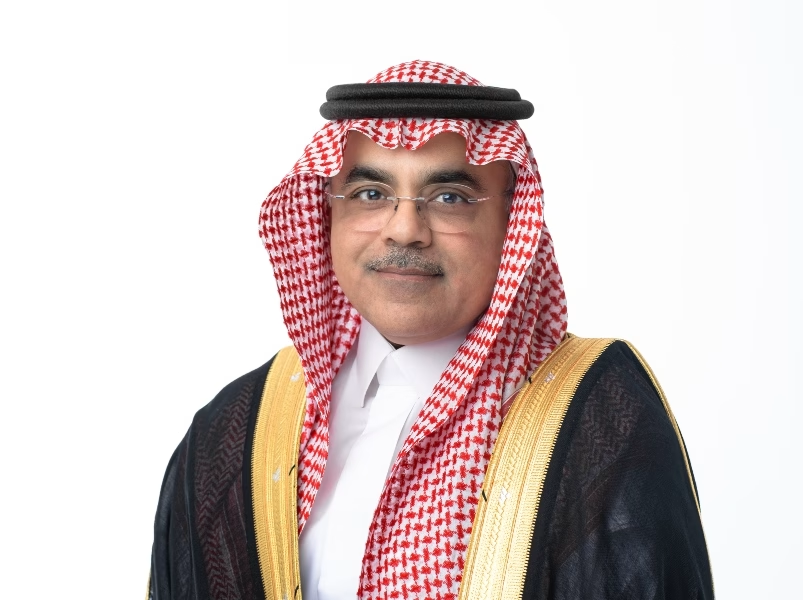
By His Excellency Eng. Khalil bin Salamah, Vice Minister of Industry and Mineral Resources for Industrial Affairs, Kingdom of Saudi Arabia
As the world gathers in Riyadh next week for the UNIDO General Conference, Africa rests on the precipice of a defining moment. This is the dawn of a new industrial age, defined not by solitary national output, but by what we build together through collaboration, innovation, and shared ambition. This moment calls for a fundamental rethinking of old models, one that calls for prioritization of open dialogue, combined strengths, global partnership. Africa now faces a decisive moment: continue down the path of industrial self-reliance, or follow the indisputable example set by South Africa’s G20 leadership and Saudi Arabia’s Vision 2030, which proves that no nation can industrialize alone.
The timing is also critical. South Africa’s historic G20 presidency, the first for an African nation, climaxed in Johannesburg this month with leaders addressing the same challenges UNIDO will tackle in Riyadh: how to finance industrial growth, close gender gaps, and unlock youth potential. Saudi Arabia’s $41 billion commitment to Sub-Saharan Africa over the next decade, announced at this year’s G20 African Energy Investment Forum, proves these aren’t just talking points.
Blended finance is now mobilizing billions toward projects previously deemed high-risk ventures. This capital can potentially unlock transformative technologies like clean hydrogen and artificial intelligence, dramatically boosting output in agriculture and industry. Nations such as Rwanda, Kenya, and South Africa have already laid the groundwork by establishing investment-friendly environments. The path forward is to unite international capital with deep local expertise. This synergy is key to empowering micro, small, and medium enterprises, thereby constructing industrial ecosystems that are both sustainable and built for scale.
Saudi Arabia is formalizing this collaboration through government-backed initiatives and corporate investments, visible on platforms like the Future Minerals Forum. Here, strategic mineral corridors, developed through Saudi-African joint ventures, are connecting Africa’s resource wealth to international supply chains. The goal is not to compete for resources, but to build complementary bridges that ensure shared and sustainable prosperity.
When Saudi Arabia invests in modernizing African mining infrastructure, it creates a clear win-win that sees Africa gaining capital and development, while the world gains a more secure and resilient supply of essential resources.
Women’s Empowerment: Unlocking Potential, Driving Innovation
Gender-responsive industrial policy isn’t progressive politics, it’s a strategic economic necessity. It has become increasingly evident that, closing gender gaps in the workforce directly increases productivity, accelerates innovation, and strengthens national competitiveness.
Around the world, we have seen important steps in this direction. Mining Charter legislation in several African nations, for example, has sought to increase women’s participation in the extractive industries. This is a welcome start, but there is room to go further, to ensure women are not only present but empowered, leading and shaping the industries of the future. Women’s role in unlocking next level industrialization, indeed, cannot be undermined.
Prioritize Youth or Forfeit the Future
Africa’s youth population of over 60% under 25 will either drive an unprecedented economic boom or trigger a profound stability crisis. Saudi Arabia’s Vision 2030 already treats this generation as critical national infrastructure, funding tangible skills programs, entrepreneurship incubators, and digital literacy campaigns. The AI revolution makes this investment urgent. Automated systems demand human oversight and creative problem-solving. Africa can develop this talent and capture the value, or stand by as other economies harness its potential.
Saudi Arabia’s approach is working. When you systematically fund youth capabilities, you build industrial leadership for decades. Countries that skip this step fall behind permanently.
A Call For Collaborative Action
The UNIDO General Conference happens November 23-27, days after South Africa’s G20 concludes. This convergence creates a platform for decisive action. This is our opportunity to move beyond declarations and initiate concrete collaborations: technology transfer mechanisms that actually work; financing structures that account for African risk profiles without punishing returns.
The Riyadh Declaration expected from the conference must move beyond aspirational language. South Africa showed at the G20 that African leadership can shape global agendas. The continent needs to maintain that momentum in every forum that matters.
Saudi Arabia’s industrial transformation happened through strategic partnerships, consistent investment, and genuine inclusion. This demonstrates how strategic policy, consistent investment, and deep commitment to inclusion can drive both rapid and sustainable industrial growth.
While our journey offers valuable insights, we recognize that global challenges require collective wisdom. We therefore present our experience as a living case study for international dialogue and extend a genuine invitation to join us in partnership, mutual learning, and collaborative progress.
The new industrial age will be written by those who bridge divides, combine strengths, and recognize that our shared challenges require shared solutions. For when history looks back on this moment, it will not judge us by the ambitions we declared, but by the enduring bridges we build.